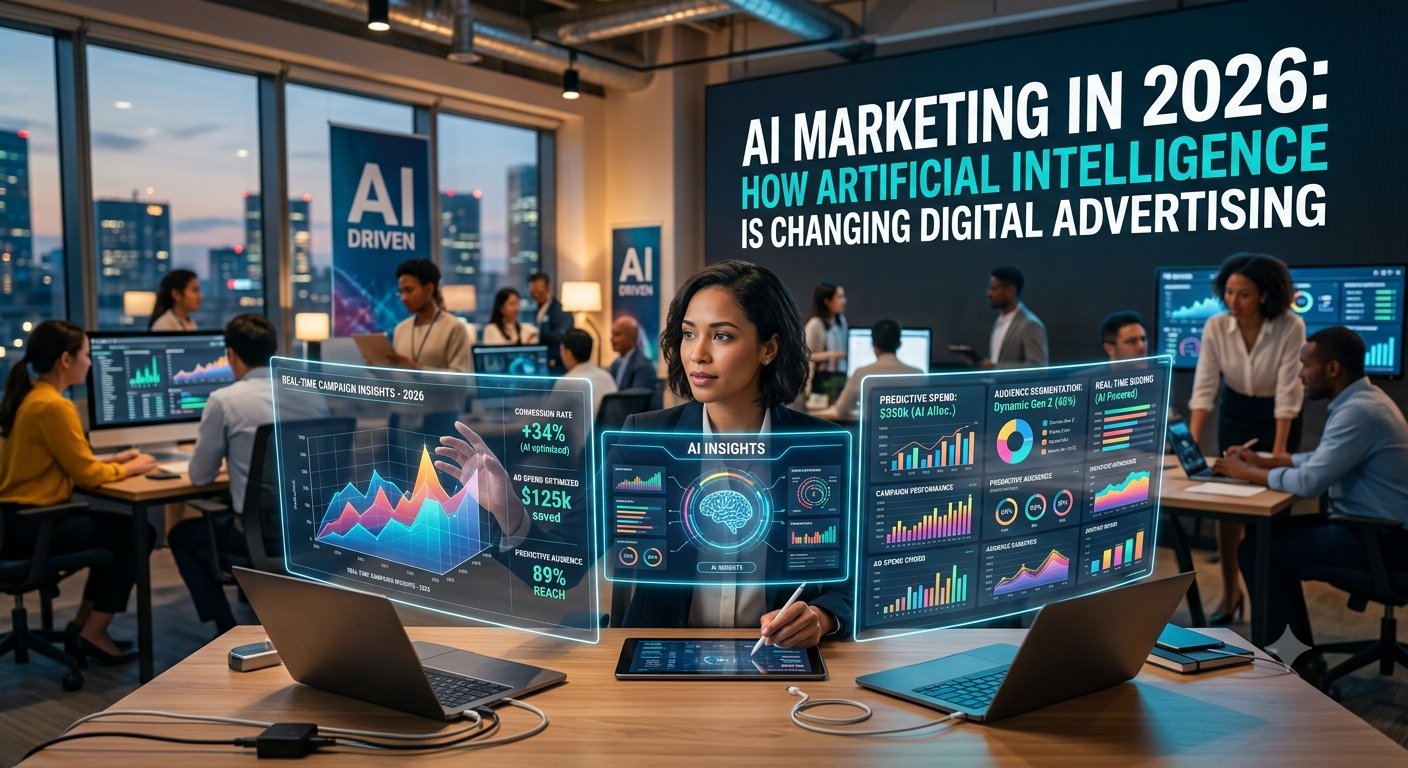
What Is Artificial Intelligence? A Beginner’s Guide to AI and Its Impact on Marketing
Artificial Intelligence (AI) is no longer a futuristic technology found only in science fiction movies. Today, AI powers many of the tools and platforms we use every day—from search engines and social media feeds to virtual assistants and personalized shopping recommendations.
In recent years, AI has evolved from a niche technology into one of the most powerful business tools available. It is transforming industries, improving productivity, and helping businesses automate tasks that once required significant time and resources.
For marketers, entrepreneurs, freelancers, and business owners, understanding AI is becoming less of an advantage and more of a necessity.
What Is Artificial Intelligence?
Artificial Intelligence refers to computer systems that can perform tasks typically associated with human intelligence. These tasks include:
- Learning from data
- Understanding language
- Solving problems
- Making decisions
- Recognizing images and speech
- Creating content
Unlike traditional software that follows fixed instructions, AI systems can analyze data, identify patterns, and improve their performance over time.
This ability to learn and adapt is what makes AI such a revolutionary technology.
A Brief History of Artificial Intelligence
The idea of intelligent machines has been around for decades.
The Early Years
In the 1950s, computer scientist Alan Turing introduced the concept known as the Turing Test, designed to determine whether a machine could imitate human conversation convincingly.
Researchers believed computers would eventually be capable of human-like thinking, but the technology of the time was not powerful enough to support these ambitions.
The AI Winters
Throughout the following decades, AI development experienced several setbacks known as "AI Winters."
These periods were marked by:
- Limited computing power
- Insufficient data
- Unrealistic expectations
- Reduced research funding
Despite these challenges, scientists continued exploring areas such as machine learning, neural networks, expert systems, and robotics.
The Modern AI Revolution
The rise of cloud computing, big data, and powerful processors sparked a major AI breakthrough during the 2010s and 2020s.
Today, AI can:
- Generate written content
- Create realistic images
- Translate languages instantly
- Write software code
- Analyze customer behavior
- Produce videos and voiceovers
- Simulate human conversations
The rapid growth of generative AI has made advanced technology accessible to anyone with an internet connection.
Types of Artificial Intelligence
Not all AI systems are the same. Most experts classify AI into three categories.
1. Narrow AI
Narrow AI is designed to perform specific tasks and is the most common form of AI used today.
Examples include:
- Chatbots
- Voice assistants
- Recommendation engines
- Image generators
- Translation tools
While highly effective, Narrow AI cannot perform tasks outside its specialized function.
2. General AI
General AI refers to a theoretical system capable of performing any intellectual task that a human can perform.
Although researchers continue to explore this possibility, General AI does not yet exist.
3. Superintelligence
Superintelligence describes a hypothetical AI system that exceeds human intelligence across all fields and disciplines.
While frequently discussed in technology circles and science fiction, Superintelligence remains a future concept rather than a current reality.
Understanding Machine Learning and Deep Learning
Machine Learning is a branch of AI that allows computers to learn from data instead of relying solely on programmed instructions.
For example, rather than teaching a computer every rule needed to identify a cat in a photo, developers can train a machine learning model using thousands of cat images. The system learns patterns and becomes increasingly accurate over time.
What Is Deep Learning?
Deep Learning is a more advanced subset of machine learning that uses artificial neural networks inspired by the structure of the human brain.
Deep learning powers many modern AI applications, including:
- Voice recognition
- Image analysis
- Autonomous vehicles
- AI writing assistants
- Generative AI tools
Advancements in deep learning have significantly accelerated AI innovation across industries.
What Is Generative AI?
Generative AI is one of the fastest-growing areas of artificial intelligence.
Unlike traditional AI systems that analyze existing data, generative AI creates entirely new content based on user instructions.
This content can include:
- Articles and blog posts
- Images and artwork
- Videos
- Music
- Software code
- Voice recordings
Popular AI tools use massive datasets and advanced language models to generate outputs that often resemble human-created content.
The instructions users provide to these systems are known as prompts, making prompt writing an essential skill in today's AI-driven world.
How AI Is Transforming Marketing
Artificial intelligence is reshaping the way businesses attract, engage, and convert customers.
Modern marketers use AI for:
- Content creation
- Search engine optimization (SEO)
- Email marketing
- Customer segmentation
- Advertising optimization
- Social media management
- Analytics and reporting
- Personalization
AI enables businesses to automate repetitive tasks while delivering more relevant experiences to customers.
For example, AI can:
- Generate ad copy
- Create social media captions
- Analyze audience behavior
- Predict customer interests
- Recommend products
- Optimize advertising campaigns automatically
As a result, marketers can spend less time on manual work and more time on strategy and creativity.
Benefits of Artificial Intelligence
The growing popularity of AI is driven by several key advantages.
Increased Productivity
AI automates repetitive tasks, helping individuals and teams accomplish more in less time.
Faster Decision-Making
AI systems can process large volumes of data quickly, uncovering insights that humans might miss.
Cost Reduction
Automation reduces operational costs and improves efficiency across departments.
Better Personalization
Businesses can use AI to deliver customized experiences, recommendations, and communications.
Improved Scalability
Small businesses can leverage AI tools to operate with capabilities once available only to large enterprises.
Challenges and Risks of AI
While AI offers enormous opportunities, it also presents several challenges.
Misinformation
AI-generated content may occasionally contain inaccurate or misleading information.
Copyright and Ownership Issues
Questions surrounding intellectual property rights and AI-generated content continue to evolve.
Job Displacement
Certain repetitive and administrative roles may become increasingly automated.
Bias and Ethics
AI systems can inherit biases from the data used to train them.
Privacy Concerns
Many AI applications require large amounts of user data, raising concerns about security and privacy.
Responsible AI adoption requires transparency, ethical practices, and human oversight.
The Future of Artificial Intelligence
Artificial intelligence is expected to continue advancing rapidly over the next decade.
Future developments may include:
- More intelligent AI assistants
- Hyper-personalized customer experiences
- Fully automated marketing systems
- AI-powered business operations
- Virtual environments generated entirely by AI
Organizations that embrace AI early are likely to gain significant competitive advantages.
Likewise, professionals who understand how to use AI effectively will be better positioned for success in the evolving digital economy.
Final Thoughts
Artificial Intelligence is transforming the way we work, communicate, create, and market products and services. From machine learning and deep learning to generative AI and marketing automation, the technology is becoming an essential part of modern business.
Understanding the fundamentals of AI is the first step toward leveraging its full potential. Whether you're a marketer, entrepreneur, freelancer, or business owner, learning how to work alongside AI can unlock new levels of productivity, creativity, and growth.
In the next article, we'll explore how Generative AI works behind the scenes and how modern AI systems create text, images, videos, and other forms of digital content.