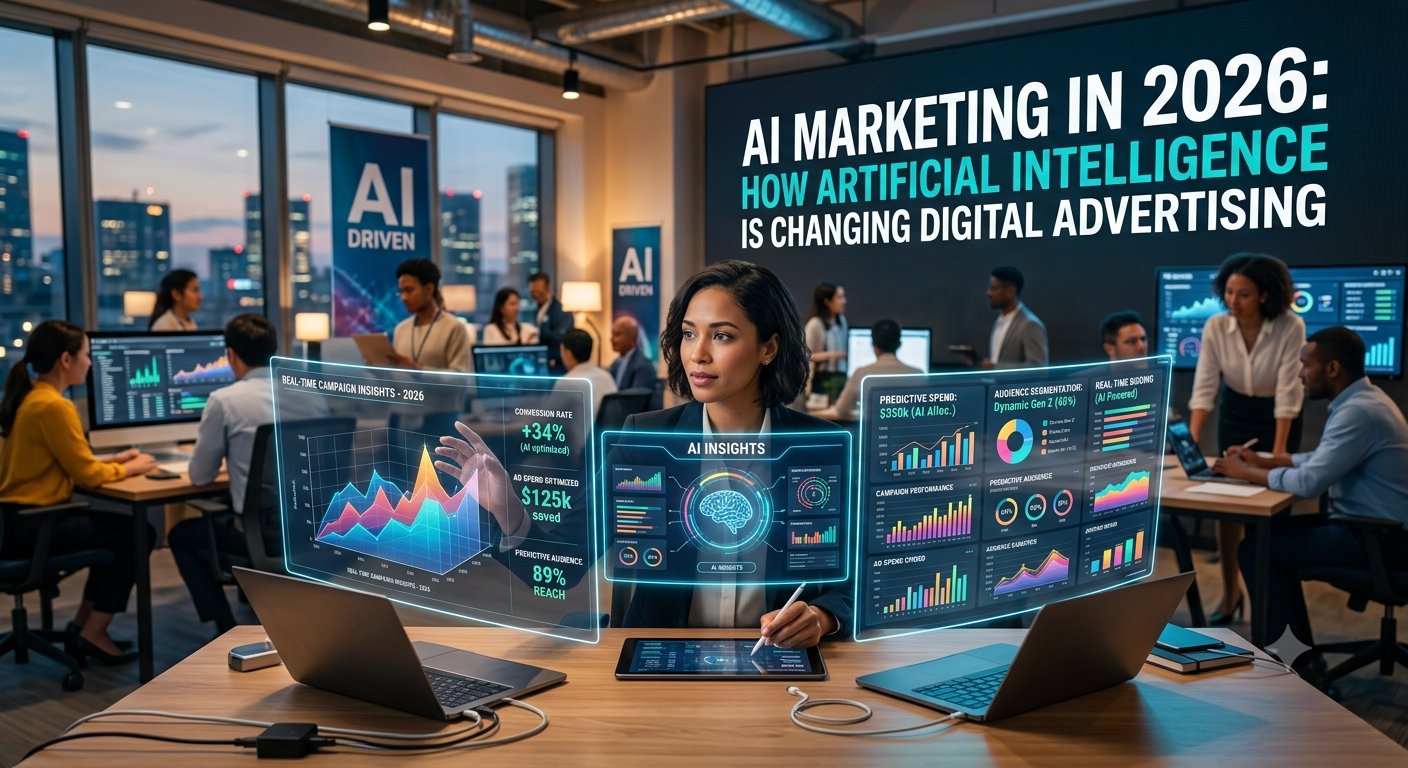
AI Marketing Mastery
The Complete Guide to AI Tools, Advertising & Automation
PREFACE
Artificial Intelligence is no longer a futuristic concept reserved for scientists and billion-dollar technology companies. It has become one of the most powerful tools available to entrepreneurs, marketers, creators, freelancers, and businesses of all sizes.
Over the past few years, AI has transformed the way people create content, run advertisements, communicate with customers, design products, edit videos, write code, and automate repetitive tasks. What once required large teams and expensive software can now be accomplished by a single individual using intelligent tools powered by machine learning and generative AI.
This book was created to help beginners and professionals understand how artificial intelligence is reshaping digital marketing and modern business. Rather than focusing only on theory, this guide is designed to provide practical strategies, real-world workflows, and actionable systems that readers can apply immediately.
Inside this book, you will learn:
* How AI tools work
* The best AI tools for marketing and business
* AI content creation systems
* AI-powered advertising strategies
* Automation workflows
* Prompt engineering
* AI business opportunities
* Ethical and legal considerations
* The future of AI marketing
The goal of this book is not to replace human creativity. Instead, it is to show how humans and AI can work together to create smarter, faster, and more efficient businesses.
Whether you are a freelancer, content creator, business owner, marketer, student, or entrepreneur, AI can help you save time, increase productivity, and unlock entirely new opportunities.
The future belongs to people who understand how to use artificial intelligence effectively. This book will help you become one of them.
---
* CHAPTER 1
* WHAT IS ARTIFICIAL INTELLIGENCE?
* Introduction
Artificial Intelligence, commonly known as AI, refers to computer systems designed to perform tasks that normally require human intelligence. These tasks include learning, reasoning, problem-solving, decision-making, language understanding, image recognition, and creativity.
AI systems are trained using large amounts of data and advanced algorithms that allow machines to recognize patterns and make predictions. Unlike traditional software that follows fixed instructions, AI systems can improve their performance over time through learning.
Today, AI is integrated into everyday life more than most people realize. Search engines, social media platforms, online shopping recommendations, navigation apps, voice assistants, and streaming services all rely heavily on artificial intelligence.
AI is rapidly changing industries such as:
* Marketing
* Healthcare
* Education
* Entertainment
* Finance
* Transportation
* Customer support
* Manufacturing
The rise of generative AI tools has made artificial intelligence accessible to ordinary users. Anyone with an internet connection can now generate text, images, videos, music, and business ideas within seconds.
---
* The History of Artificial Intelligence
The concept of artificial intelligence has existed for decades. Scientists and mathematicians began exploring the idea of intelligent machines during the mid-20th century.
* Early Foundations
In the 1950s, computer scientist Alan Turing introduced the famous “Turing Test,” a method used to determine whether a machine could imitate human intelligence convincingly.
Researchers believed computers could eventually learn to think like humans. However, early computers lacked the power and data necessary to achieve advanced AI capabilities.
* The AI Winters
Artificial intelligence experienced several periods known as “AI winters,” during which progress slowed due to limited computing power, unrealistic expectations, and lack of funding.
Despite setbacks, research continued in areas such as:
* Neural networks
* Expert systems
* Machine learning
* Robotics
* Modern AI Revolution
The explosion of internet data, cloud computing, and powerful graphics processors led to rapid breakthroughs in AI development during the 2010s and 2020s.
Modern AI systems can now:
* Generate human-like text
* Create realistic images
* Translate languages
* Write software code
* Produce videos
* Simulate conversations
* Analyze customer behavior
Generative AI has become one of the fastest-growing technologies in history.
---
* Types of Artificial Intelligence
Artificial intelligence can be divided into several categories.
* Narrow AI
Narrow AI is designed to perform specific tasks. Most AI systems today fall into this category.
Examples include:
* Voice assistants
* Recommendation systems
* Image generators
* Chatbots
* Translation software
Narrow AI is highly effective within its specialized area but cannot perform general reasoning like humans.
* General AI
General AI refers to a theoretical form of AI capable of performing any intellectual task that a human can do.
This type of AI does not yet exist. Researchers continue exploring whether it will become possible in the future.
* Superintelligence
Superintelligence is a hypothetical AI system that surpasses human intelligence in every field.
While frequently discussed in science fiction, superintelligence remains speculative.
---
* Machine Learning and Deep Learning
Machine learning is a branch of AI that enables systems to learn from data rather than following fixed programming rules.
For example, instead of manually teaching a computer every rule for identifying cats in images, machine learning systems analyze thousands of examples and learn patterns automatically.
* Deep Learning
Deep learning is a more advanced form of machine learning that uses neural networks inspired by the human brain.
Deep learning powers:
* Image recognition
* Speech recognition
* AI writing tools
* Self-driving systems
* Generative AI
The growth of deep learning has significantly accelerated AI development.
---
* Generative AI
Generative AI refers to systems capable of creating entirely new content.
This includes:
* Text
* Images
* Music
* Videos
* Code
* Voiceovers
Generative AI models are trained using enormous datasets collected from books, websites, images, audio files, and other digital content.
Popular generative AI applications include:
* AI chatbots
* AI art generators
* AI music creators
* AI video tools
These systems predict patterns and generate outputs based on user instructions called prompts.
---
* How AI Is Used in Marketing
Artificial intelligence has transformed digital marketing.
Modern businesses use AI for:
* Ad targeting
* Email marketing
* Customer segmentation
* Social media content
* SEO optimization
* Chatbots
* Analytics
* Personalization
AI helps marketers:
* Save time
* Reduce costs
* Improve customer engagement
* Increase conversions
* Scale campaigns faster
For example, AI can automatically:
* Generate advertising headlines
* Create social media captions
* Analyze audience behavior
* Predict customer interests
* Optimize campaigns in real time
---
* Advantages of Artificial Intelligence
AI offers many benefits for businesses and individuals.
* Increased Productivity
AI automates repetitive tasks, allowing people to focus on creativity and strategy.
* Faster Decision-Making
AI analyzes data quickly and identifies useful patterns.
* Cost Reduction
Businesses can reduce operational expenses through automation.
* Personalization
AI helps companies deliver personalized recommendations and experiences.
* Scalability
Small businesses can operate like larger organizations using AI tools.
---
* Risks and Challenges
Despite its benefits, AI also presents several challenges.
* Misinformation
AI-generated content can sometimes contain false or misleading information.
* Copyright Concerns
Questions remain regarding ownership of AI-generated content.
* Job Displacement
Some repetitive jobs may become automated.
* Ethical Concerns
AI systems can reflect bias from training data.
* Privacy Issues
AI systems often require large amounts of user data.
Responsible AI usage is becoming increasingly important.
---
* The Future of AI
Artificial intelligence is expected to continue evolving rapidly over the next decade.
Future developments may include:
* Advanced AI assistants
* Hyper-personalized advertising
* AI-powered businesses
* Fully automated workflows
* AI-generated virtual worlds
Companies that learn to adapt early will gain significant advantages.
Individuals who understand AI tools and workflows will likely have more opportunities in the future digital economy.
---
* Chapter Summary
Artificial intelligence is transforming the modern world at an unprecedented pace. From content creation to marketing automation, AI has become a powerful tool for businesses and creators alike.
Understanding the foundations of AI is the first step toward using these technologies effectively and responsibly.
In the next chapter, we will explore how generative AI works and how modern AI systems create text, images, videos, and other forms of content.